
I'm an extremely prejudiced critic when it comes to Downton Abbey. But really, how can anyone with a heart not be? I could watch the scenery alone for seven episodes. As for the ensemble of characters that Fellowes depicts so adeptly, everyone is a distinct personality; their relationships are so true to life. You really start to develop feelings for the Crawleys and their staff. At least I did. But that's probably because I'm a romantic-relationship-starved blogger.

If I had a shilling for every time I cried over this couple...
Some critics call Downton Abbey a "soap opera" for sophisticated viewers; I don't agree. Just because this miniseries has an exciting plot, that doesn't make it a "soap opera." Some high-brow intellectual writers de-emphasize the plot too much; they think that an intriguing plotline and real literary merit are mutually exclusive, save in Mark Twain or something. Fellowes may be a snobbish aristocrat, but he's also a brilliant screenwriter.
Season 2 is what many a TV journal calls an "emotional rollercoaster." I prefer "catharsis." After each of the first four episodes, I cried like a premature newborn baby. As such, I only have a few criticisms.
Season 2 was slightly less brilliant than Season 1. A few plotlines seem curiously out of place. For instance, when the defigured former heir Patrick Gordon/Crawley comes back to try and steal Matthew's inheritance, there never is a resolution, except that Edith is left heartbroken.
Another thing that isn't quite to my taste is Fellowes' extreme lauding of the English peerage, sometimes at the expense of the other classes. Sir Richard Carlisle, a self-made man who probably rose from a middle class family, is depicted as a money- and power-hungry maniac who torments Mary. His character was well-acted by the marvelous Iain Glen, but not at all dynamic.
The icing on the Downton cake is, hands down, Dame Maggie Smith. Need I say more? No, I shan't. My opinions are too middle class for the Dowager Countess of Grantham.
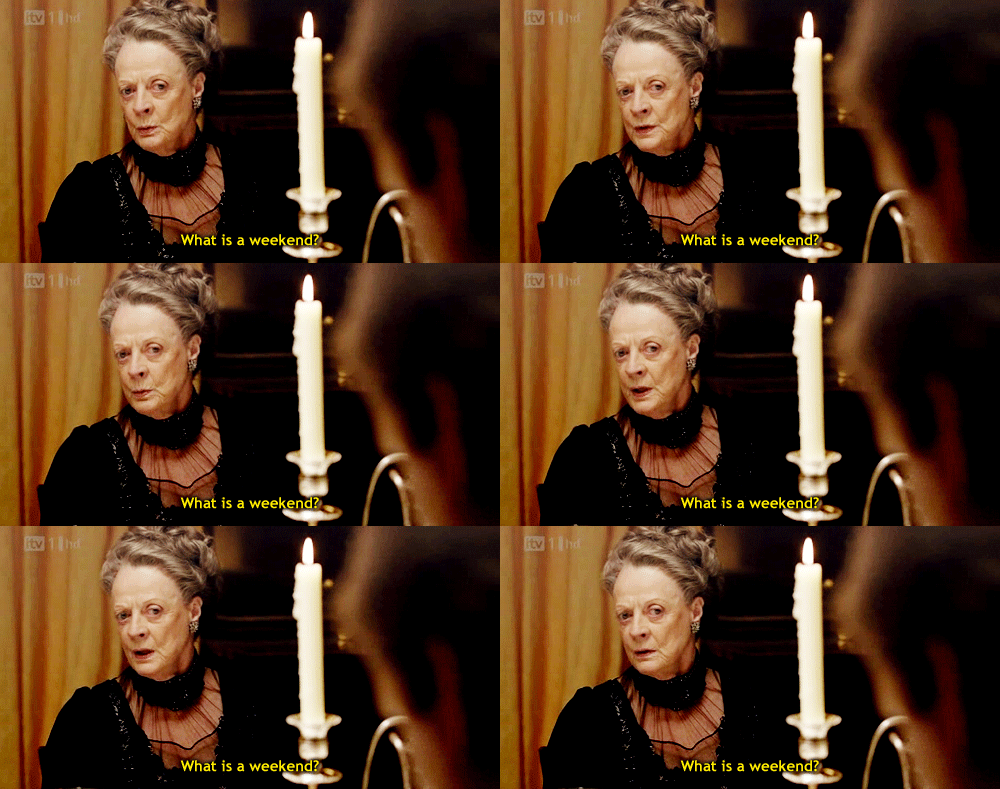
Your explanation is invalid.
As a devout Downton fan living in America, I find the five month long wait for the "PBS version" to air utterly unbearable. I watched Season 1 on Masterpiece Theatre, and fell in love with the series. This time around, for Season 2, I couldn't stand to wait so long. I freely admit, at the risk of incurring Lord Hugh Bonneville's displeasure, that I watched pseudo-legal uploads of Season 2 long before their US air date, thanks to livestreams supplied by my lovely British friends.
I have several reasons for my "criminal" actions. The first is that PBS cuts the episodes short to accommodate American TV times. Second, all my internet friends are British; listening to their gloating for five months--no, just NO. Honestly, I don't think this kind of "piracy" damages the revenue earned by Downton Abbey and related merchandise. I bought Season 2 DVDs and a Downton Abbey calendar, all imported from the UK, because I had watched the episodes online.
One thing I do love about the American Downton is the viewer interaction. If you're not watching the Super Bowl tonight (I mean, why would you? Downon Abbey is on at the same time!), tune in to the Twitter hashtag #DowntonPBS and make sure you follow @Austenprose, @VanityFair, @tomandlorenzo and @pattonoswalt. They live tweet the Downton episodes. Sample tweets include "@Austenprose: "Hisssss. Mrs. Bates flies into Downton on her broom" and "@pattonoswalt: That long-handled shoehorn was the iPhone 4S of 1916."
If you still don't think Downton Abbey is cool, go read this article titled Downton. Muthafu--kin' Abbey. Damn right.

